How to Calculate TMT Bar Requirements for Your House and Avoid Costly Buying Mistakes
Planning a house construction project involves managing several expenses, from cement and aggregates to labour and reinforcement steel. Among these, TMT bars are an important purchase because they contribute to the strength of reinforced concrete elements.
Ordering too little steel can interrupt construction, while ordering excessive quantities can tie up money and create storage challenges. So how do you estimate the TMT bars required for your house?
The process begins with your structural drawings and the reinforcement quantities specified by your structural engineer. Understanding how steel weight is calculated can then help you check quotations, compare rates and plan purchases more effectively.
Step 1: Start With the Structural Drawings
The quantity of reinforcement steel depends on the building’s design, including its dimensions, number of floors, structural system, loads and foundation conditions. A structural engineer prepares reinforcement details that specify the required bar diameters, spacing, lengths, bends and other detailing requirements.
These details are generally reflected in reinforcement drawings and a Bar Bending Schedule (BBS). A BBS lists reinforcement bars by structural element and provides information such as diameter, cutting length, shape and quantity. It is one of the most useful documents for estimating steel requirements.
Do not estimate your entire requirement simply from the built-up area or number of floors. Two houses with the same floor area can require different reinforcement quantities.
Step 2: Understand the Common TMT Bar Sizes
TMT bars are available in a range of diameters, including:
· 8 mm
· 10 mm
· 12 mm
· 16 mm
· 20 mm
· 25 mm
· 32 mm
Different diameters may be specified for different structural elements, depending on the engineering design. For example, a project may use smaller-diameter bars for certain reinforcement requirements and larger bars in other elements. The actual arrangement must come from the approved drawings.
Never change the specified diameter or spacing just to reduce the steel bill without approval from the structural engineer.
Step 3: Calculate the Approximate Weight of a TMT Bar
One useful formula for estimating the nominal weight of a round steel bar is:
Weight per metre (kg) = Diameter² ÷ 162
In this formula, the diameter is measured in millimetres. For example, for a 12 mm bar:
Weight per metre = 12 × 12 ÷ 162
Weight per metre ≈ 0.889 kg
A 12 mm bar measuring 12 metres would therefore have an approximate nominal weight of:
0.889 × 12 = 10.67 kg
This formula is a convenient estimation tool. Actual supplied weight should be assessed according to the applicable standard, permitted tolerances and the product’s specifications.
Step 4: Refer to This TMT Bar Weight Table
The following table shows approximate nominal weights for commonly used bar diameters.
TMT bar diameter Approx. weight per metre Approx. weight for 12 m
8 mm 0.395 kg 4.74 kg
10 mm 0.617 kg 7.41 kg
12 mm 0.889 kg 10.67 kg
16 mm 1.580 kg 18.96 kg
20 mm 2.469 kg 29.63 kg
25 mm 3.858 kg 46.30 kg
32 mm 6.321 kg 75.85 kg
These values are approximate and based on the nominal weight formula. Confirm the actual product specifications and supplied lengths when placing an order.
Step 5: Calculate Total Steel Weight From the Bar Bending Schedule
Once you have the BBS, you can estimate the steel requirement by multiplying the number of bars by their respective lengths and nominal weights.
For example, suppose a hypothetical reinforcement schedule specifies 100 bars of 12 mm diameter, each with a cutting length of 6 metres.
Total length = 100 × 6 = 600 metres
Approximate total weight = 600 × 0.889
Approximate total weight = 533.4 kg
This is an illustrative calculation, not a recommendation for the number or arrangement of bars in a real building. Repeat the calculation for each bar diameter and cutting length in the BBS. Add the individual quantities to obtain the estimated total.
For an actual project, the engineer’s schedule should account for the required bends, hooks, laps and other detailing as applicable.
Step 6: Account for Cutting Waste and Procurement Requirements
Steel requirements can be affected by cutting plans, handling, storage and the difference between calculated quantities and the way material is supplied. However, it is important not to add an arbitrary wastage percentage without considering the project.
The cutting and utilisation plan, available bar lengths, specified laps and handling arrangements all affect the quantity that should be ordered. Ask your contractor or engineer to confirm the procurement quantity and an appropriate allowance for the project. Where suitable, planning cutting lengths carefully can help reduce avoidable offcuts.
Step 7: Calculate the Purchase Cost
Once the estimated quantity is known, you can compare supplier quotations. Suppose your confirmed requirement is 5,000 kg and the quoted steel rate is ₹60 per kg.
Estimated base steel cost = 5,000 × ₹60
Estimated base steel cost = ₹3,00,000
This is only an illustrative example. It excludes any applicable GST, transportation, unloading and other charges unless those are already included in the quoted rate. Before placing your order, confirm the current rate, applicable taxes, delivery charges, agreed quantity and payment terms.
Step 8: Avoid These Common TMT Purchasing Mistakes
Buying only on the basis of price
A lower quotation is not necessarily the better deal if it relates to a different grade, quantity or specification. Compare equivalent products and the complete delivered cost.
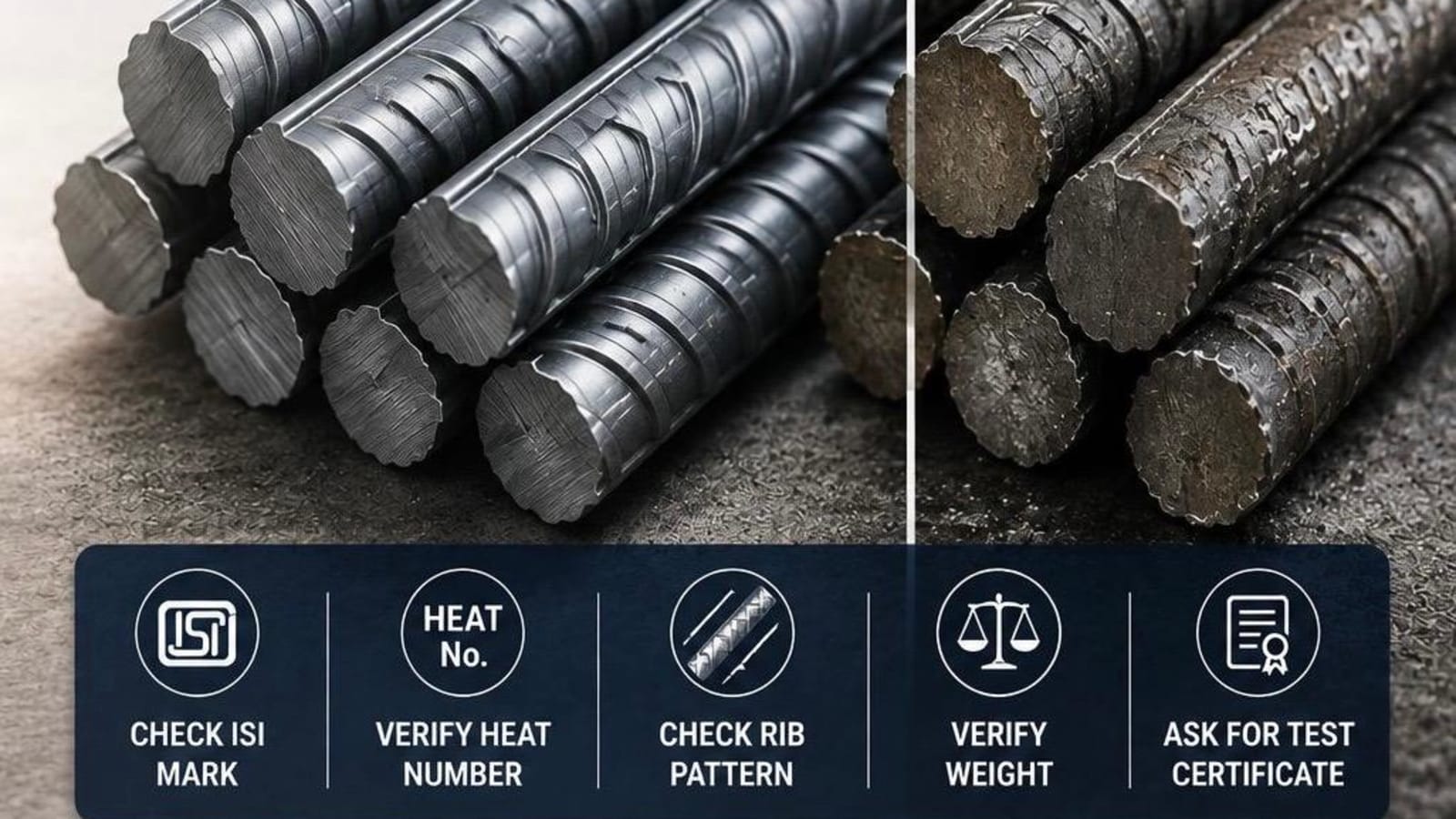
Ignoring weight verification
Since steel is commonly purchased by weight, keep a clear record of the ordered quantity, supplied quantity and invoice. Ask your supplier about weight verification arrangements.
Ordering without confirming sizes
Your order should reflect the required diameters and quantities. An incorrect size mix can create unnecessary procurement and site-management complications.
Overlooking delivery coordination
Steel deliveries should be planned around the construction schedule and safe storage arrangements. Confirm availability and dispatch timing before relying on a delivery date.
Estimating reinforcement from floor area alone
General per-square-foot estimates can be useful for early budgeting, but they cannot replace a project-specific reinforcement schedule.
How Baheti Steel Traders Can Help
Baheti Steel Traders LLP supplies TMT bars to homeowners, builders and construction professionals across Hyderabad and Secunderabad. Since 1975, our business has focused on steel procurement with attention to fair weight, specified sizes, transparent pricing and coordinated dispatch.
If you have a confirmed requirement, our team can help you enquire about available brands, diameters and current quotations. Sharing your required quantities and sizes makes it easier to discuss the most suitable supply arrangement.
Conclusion
Calculating your TMT bar requirement begins with accurate structural drawings and a Bar Bending Schedule. Using the nominal weight formula helps you estimate quantities and understand supplier quotations, while careful procurement planning can reduce avoidable delays and purchasing errors. The most important step is to ensure that your steel order matches the approved structural design.
Need TMT bars for your construction project in Hyderabad or Secunderabad? Contact Baheti Steel Traders for available sizes, pricing and delivery enquiries.
Disclaimer: This article is for general educational purposes. Actual reinforcement quantities, bar sizes, cutting lengths and detailing must be determined by the qualified structural engineer for your project.