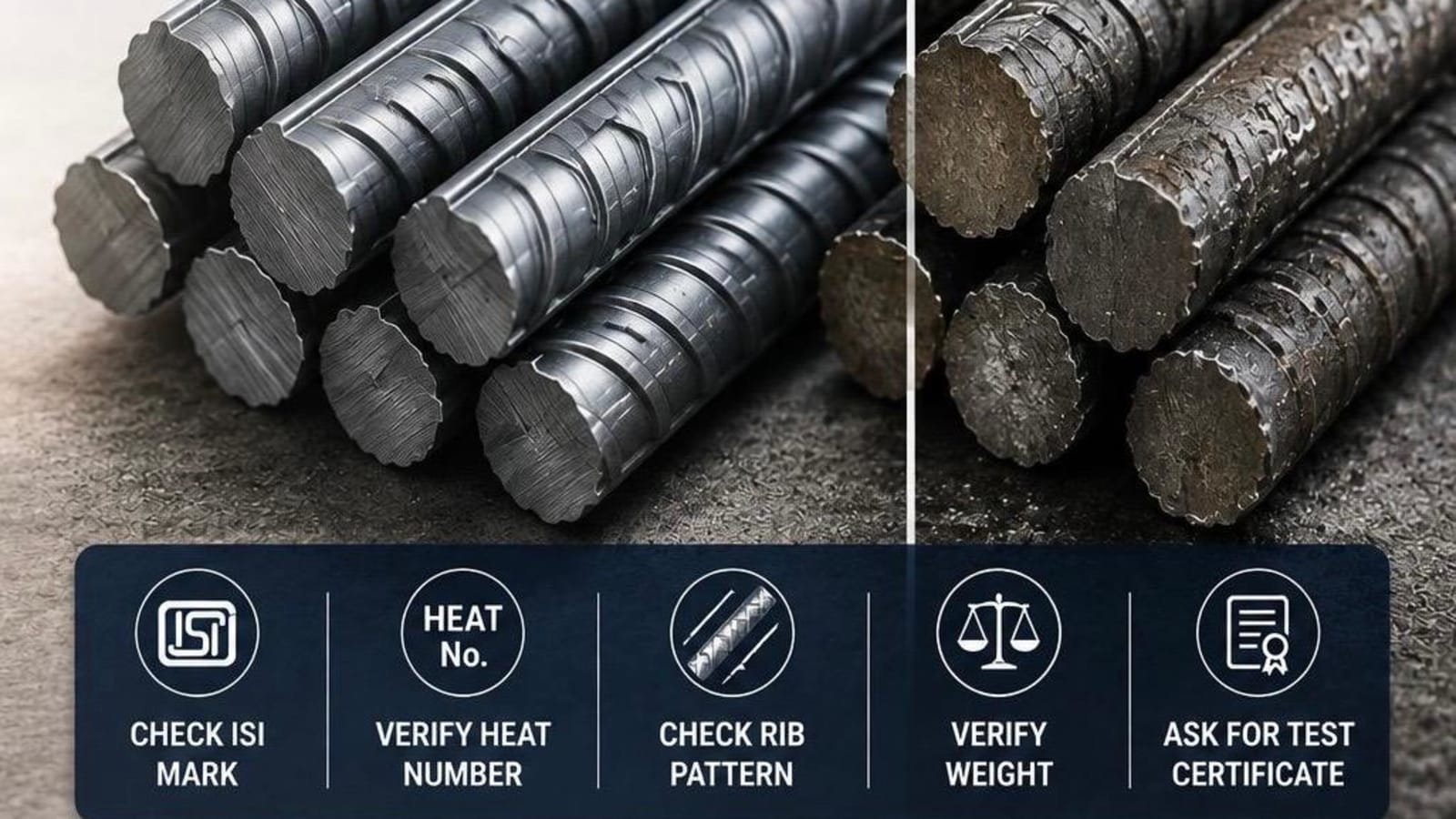
Counterfeit and duplicate TMT bars are a persistent problem in the steel trade — and one of the more dangerous ones, because the visual difference between a genuine bar and a duplicate can be almost impossible to spot with an untrained eye. These bars often enter the market at a discount that looks attractive on a quote, but the real cost shows up later, in a structure that doesn't perform the way its design assumes it will.
This guide covers the practical checks any buyer — contractor, site engineer, or building owner — can use before accepting a large TMT order.
Why Counterfeiting Happens in This Industry
TMT bars from reputed manufacturers carry a brand premium, because that brand represents a guarantee of consistent chemical composition, tested mechanical properties, and manufacturing quality control. Counterfeiters exploit this by producing bars that mimic the visual appearance of branded bars — sometimes even replicating embossing — while cutting corners on the actual metallurgy and manufacturing process. The result looks like a genuine bar on the surface but can fall well short of its stated grade in actual strength and ductility.
1. Check the Brand Embossing Carefully
Genuine bars from reputed manufacturers have the brand name, grade (Fe500, Fe550, Fe600, etc.), and often an ISI mark embossed at regular, consistent intervals along the length of the bar. When checking a bundle:
Look for consistent depth and clarity of embossing across multiple bars, not just one sample
Check that the grade marking matches what you ordered and what's on the invoice
Be suspicious of embossing that looks shallow, smudged, or inconsistent from bar to bar within the same bundle
Counterfeiters can replicate embossing reasonably well, so this check alone isn't conclusive — but inconsistency here is often the first visible red flag.
2. Always Ask for the Mill Test Certificate (MTC)
Every genuine batch should be accompanied by an MTC — a document from the manufacturer's mill showing the batch's chemical composition (carbon, manganese, sulphur, phosphorus content) and mechanical test results (yield strength, ultimate tensile strength, elongation percentage). When you receive one:
Cross-check the batch or heat number on the certificate against markings on the physical bars, where present
Confirm the test values actually meet the IS 1786 requirements for the claimed grade, not just that a certificate exists
Be wary of suppliers who are reluctant to provide an MTC for a substantial order, or who offer one that seems generic or reused across unrelated orders
3. Inspect the Surface and Rib Pattern
Genuine TMT bars go through a specific thermo-mechanical treatment process that produces a tempered martensitic outer rim with a softer ferrite-pearlite core — this is what gives TMT bars their combination of high surface hardness and core ductility. Visually and physically, this shows up as:
A consistent, evenly spaced rib pattern along the bar's length
A uniform surface finish without irregular pitting or rough patches
If you ever have the opportunity to check a cut cross-section, a genuine TMT bar will show a visibly different (usually darker) outer ring compared to the core — duplicate bars manufactured without proper thermo-mechanical treatment often lack this distinct ring, or show inconsistent ribbing from an inferior rolling process.
4. Treat Unusually Low Pricing as a Signal to Investigate, Not a Bargain
If a quote for a specific brand and grade comes in significantly below prevailing market rates, that gap has to come from somewhere. Sometimes it's a genuine promotional rate or bulk discount — but often, it reflects a supplier passing off duplicate material as genuine, or substituting a lower grade than what's being billed. Before accepting a price that seems too good, ask directly how it compares to current market rates for that brand and grade, and be prepared to verify quality more rigorously if the answer doesn't add up.
5. Buy From Authorized Dealers
The single most effective way to avoid this risk altogether is sourcing from a dealer who is formally authorized by the manufacturer. Authorized dealers are accountable back to the brand for what they sell — which means they have a direct business incentive to ensure what reaches you is genuine, properly documented, and traceable to the original mill batch. This accountability chain is difficult to replicate through informal or unauthorized sourcing, however competitive the pricing looks.
What to Do If You Suspect a Batch Is Duplicate
If a delivered batch fails these checks — inconsistent embossing, no MTC, irregular surface finish — the safest move is to pause acceptance and raise it with your supplier before the material goes into the structure. Once TMT bars are embedded in concrete, verification becomes far harder and far more expensive.
Final Word
None of these checks are difficult or time-consuming individually, but together they build a real layer of protection against a risk that's genuinely present in this industry. A few minutes of verification at delivery is a small price for the assurance that what's going into your structure is what you actually paid for.
At Baheti Steel Traders, we are authorized dealers, and every batch we supply is traceable back to the mill with proper documentation — so you never have to run these checks on faith.