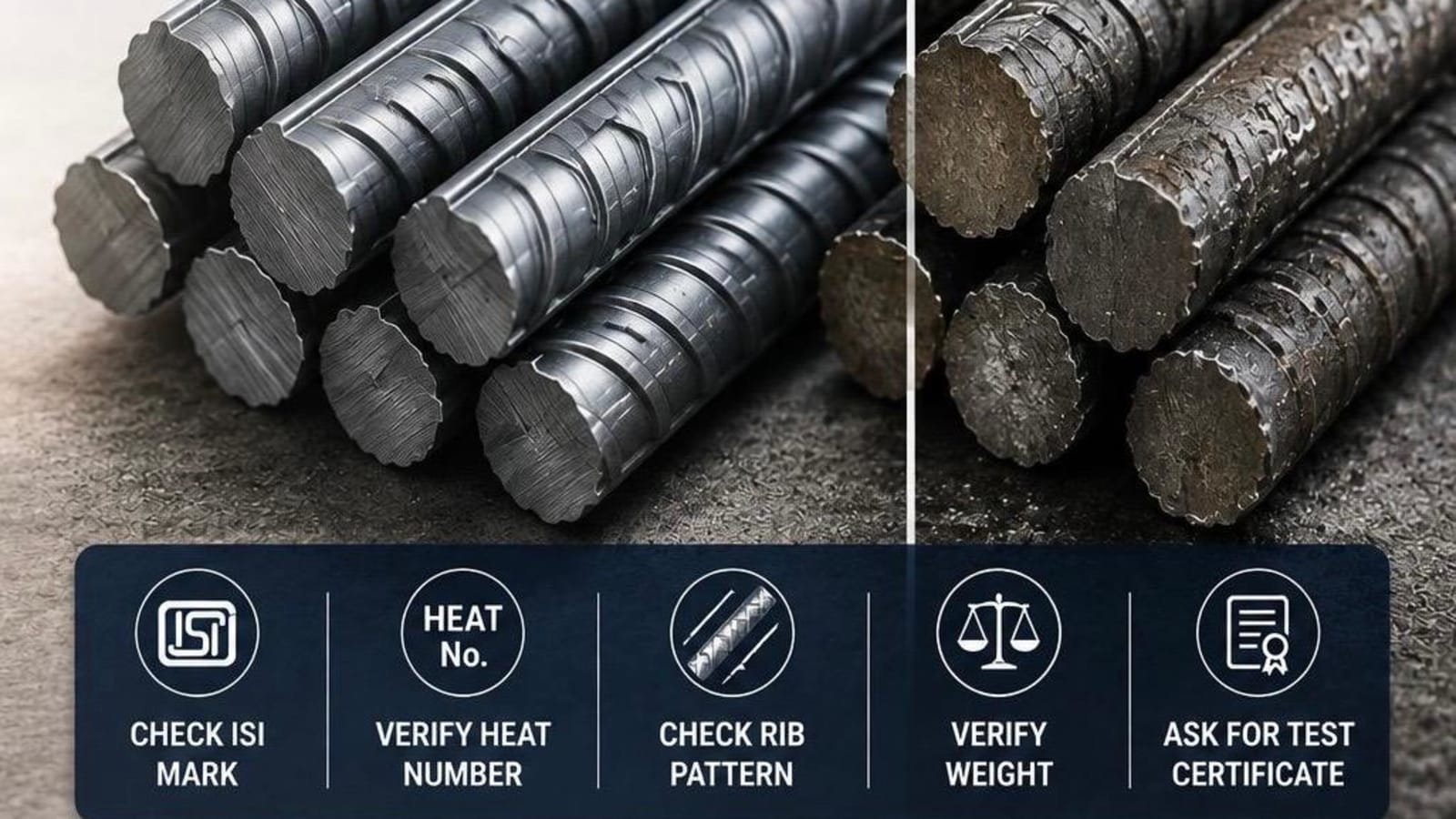
Most buyers know TMT bars are sold by weight — per tonne or per kilogram — rather than by piece. What fewer buyers realize is that this creates a specific verification opportunity: every bar diameter has a defined standard weight per metre under IS 1786, the Indian Standard governing high-strength deformed steel bars for concrete reinforcement. If you know these numbers, you can verify what you're actually receiving against what you're being billed for — and that's a genuinely useful check to have in your back pocket.
Why Weight-Based Selling Exists
Selling by weight rather than piece count makes sense because a bar's strength contribution comes from its cross-sectional area and length, not simply "one bar." Weight is a reliable proxy for the actual quantity of steel you're getting, provided the bars are manufactured to standard dimensional tolerances. This is exactly why deviations from standard weight-per-metre values matter — they signal either dimensional shortfall or something off in how a batch was produced.
Standard Weight Per Metre (IS 1786)
Here are the approximate standard weights per metre for common TMT bar diameters:
8mm: 0.395 kg/m
10mm: 0.617 kg/m
12mm: 0.888 kg/m
16mm: 1.578 kg/m
20mm: 2.466 kg/m
25mm: 3.853 kg/m
32mm: 6.313 kg/m
These figures follow directly from the bar's nominal cross-sectional area and the density of steel (roughly 7850 kg/m³) — they're not arbitrary numbers, which is exactly why they're a reliable benchmark to check against.
Standard Length
TMT bars in the Indian market are most commonly supplied in 12-metre lengths, though 13-metre lengths also appear depending on the manufacturer and mill practice. It's worth confirming length at the time of order, since a mismatch here affects your total quantity calculations even if weight per metre is correct.
How to Actually Use This as a Buyer
Here's the practical check: if you order a bundle of, say, 12mm bars and know the bundle contains a certain number of 12-metre-length bars, you can calculate the expected total weight (bars × length × 0.888 kg/m) and compare it against the weighbridge slip or invoice. A meaningful shortfall — beyond normal manufacturing tolerance — is worth raising with your supplier before you accept the batch.
This matters most on large orders, where even a small percentage shortfall across tonnes of steel adds up to a real quantity of "missing" reinforcement in your structure.
The Role of the Mill Test Certificate (MTC)
Beyond weight, every genuine batch of TMT bars should come with a Mill Test Certificate — a document from the manufacturer showing the batch's chemical composition and mechanical test results (yield strength, tensile strength, elongation). Always ask for this, and where possible, cross-check the batch number on the certificate against what's physically been delivered. A supplier who can't produce an MTC for a large order is a signal to pause and ask more questions.
Why This Protects You, Not Just Your Supplier
It might seem like this level of verification is adversarial, but it isn't — reputable suppliers welcome this kind of check because it protects everyone's credibility. Underweight or substandard steel isn't just a commercial loss; it's a structural risk that eventually becomes someone's liability, whether that's the contractor, the engineer, or the building owner. A buyer who checks weight and asks for documentation is simply doing responsible due diligence, and any supplier worth working with will respect that.
Final Word
Knowing the IS 1786 weight-per-metre standards turns a routine delivery into a verifiable transaction. It costs you a few minutes of arithmetic and protects you from a risk that's otherwise easy to miss until it's too late.
At Baheti Steel Traders, every batch we supply is verifiable against IS 1786 standards, with full documentation — including MTCs — available on request for every order, large or small.