This article is meant to help readers understand how TMT bar diameter works and what it affects. It isn't a substitute for structural design — the diameter and spacing used in your project should always come from your structural engineer's drawings.
Ask around a steel yard and you'll often hear simplified advice: "residential buildings use 8–12mm," "commercial buildings use 12–20mm," "industrial structures use 20–32mm." It's an easy shortcut, but it isn't technically accurate, and leaning on it can create a false sense of confidence about what a structure actually needs. Bar diameter isn't chosen based on what category of building you're putting up — it's chosen based on structural design: span, loads, member dimensions, number of floors, seismic requirements, and detailing. A two-storey home could legitimately call for 16mm, 20mm, or even 25mm bars in certain columns, while some elements of a larger commercial structure might use smaller bars. There's no shortcut that replaces the calculation.
This guide is meant to help you understand what diameter actually does, how it relates to grade, and why the real answer to "what size do I need" always comes back to your engineer's drawings.
What Diameter Actually Determines
TMT (Thermo-Mechanically Treated) bars are reinforcement — embedded in concrete to give it tensile strength, since concrete on its own resists compression well but is weak in tension. A bar's diameter determines its individual cross-sectional area, and a larger bar can carry more tensile force on its own, all else being equal.
But it would be misleading to say that a larger diameter simply means "more structural capacity" for a member. What actually matters is the total reinforcement area in that member, how the bars are arranged and spaced, the concrete grade, the member's dimensions, and the shear reinforcement and detailing around it. Four 12mm bars and two 16mm bars, for instance, don't provide the same reinforcement area or the same structural behaviour — the difference isn't just "which number is bigger." This is exactly the kind of comparison a structural engineer works out during design, not something to eyeball on-site.
Diameter and Grade Are Two Different Things
It's worth being clear about a distinction that's easy to blur: diameter (8mm, 10mm, 12mm, 16mm, and so on) describes the physical size of the bar, while grade (Fe 415, Fe 500, Fe 500D, Fe 550, Fe 550D) describes its mechanical properties — yield strength and ductility. A 12mm Fe 500D bar and a 12mm Fe 550D bar are the same size but behave differently under load. Neither diameter nor grade should be chosen in isolation from the other, and neither should be assumed to be "better" just because the number is higher — the applicable design code and the specific structural requirement determine the right combination, including where ductility matters more than raw strength.
Bar Sizes Commonly Available in the Market
TMT bars under IS 1786 cover a wide range of nominal sizes, but the diameters most commonly stocked and used in general construction in the Indian market are 8mm, 10mm, 12mm, 16mm, 20mm, 25mm, and 32mm. (IS 1786 itself technically extends further, including smaller and larger nominal sizes, though these are less commonly stocked for standard building construction.) Not every yard carries every size in every brand, so it's worth confirming availability against your BOQ (Bill of Quantities) before finalizing a size that might be hard to source locally.
How Diameter Is Typically Used Across a Structure — Subject to Design
With the caveat that the actual figures always come from the structural drawings, it's true that different structural elements tend to use different diameter ranges in practice:
Slabs: Slabs commonly use smaller-diameter reinforcement such as 8mm, 10mm, or 12mm, used as distribution or main reinforcement depending on the specific design, span, and loading. This isn't a fixed rule — some slab designs call for other sizes depending on span and load.
Beams: Beam reinforcement often combines diameters — larger bars for main tension reinforcement, smaller bars for stirrups and shear reinforcement — with the specific combination coming from span, load, and detailing requirements.
Columns: Column longitudinal reinforcement is generally larger than slab reinforcement and can include 16mm, 20mm, 25mm, 32mm, or larger bars depending on the design — it should not be assumed that 12mm or 16mm is automatically sufficient for a column. Ties and stirrups around those main bars are a separate reinforcement requirement with their own detailing rules.
Footings and foundations: Foundation reinforcement varies with soil-bearing capacity and the load being transferred to the ground, and can span a wide range of diameters depending on the specific design.
Larger or heavier structures: Bigger spans, taller structures, and higher loads generally push designs toward larger diameters or denser reinforcement in critical members — but again, this comes from calculation, not a rule tied to "how big the building is."
A Note on Earthquake-Resistant Design
It's worth flagging a common misconception directly: neither a larger bar diameter nor a higher steel grade, on its own, makes a building earthquake-resistant. Seismic performance is primarily a function of the overall structural system, ductile detailing, reinforcement arrangement, connections, and compliance with the applicable seismic design provisions. A ductile grade like Fe 500D can be a sensible choice where ductility matters, but it's one input among many in a much larger design picture — not a shortcut to "earthquake-proofing" a structure on its own.
A Commercial Risk Worth Knowing About
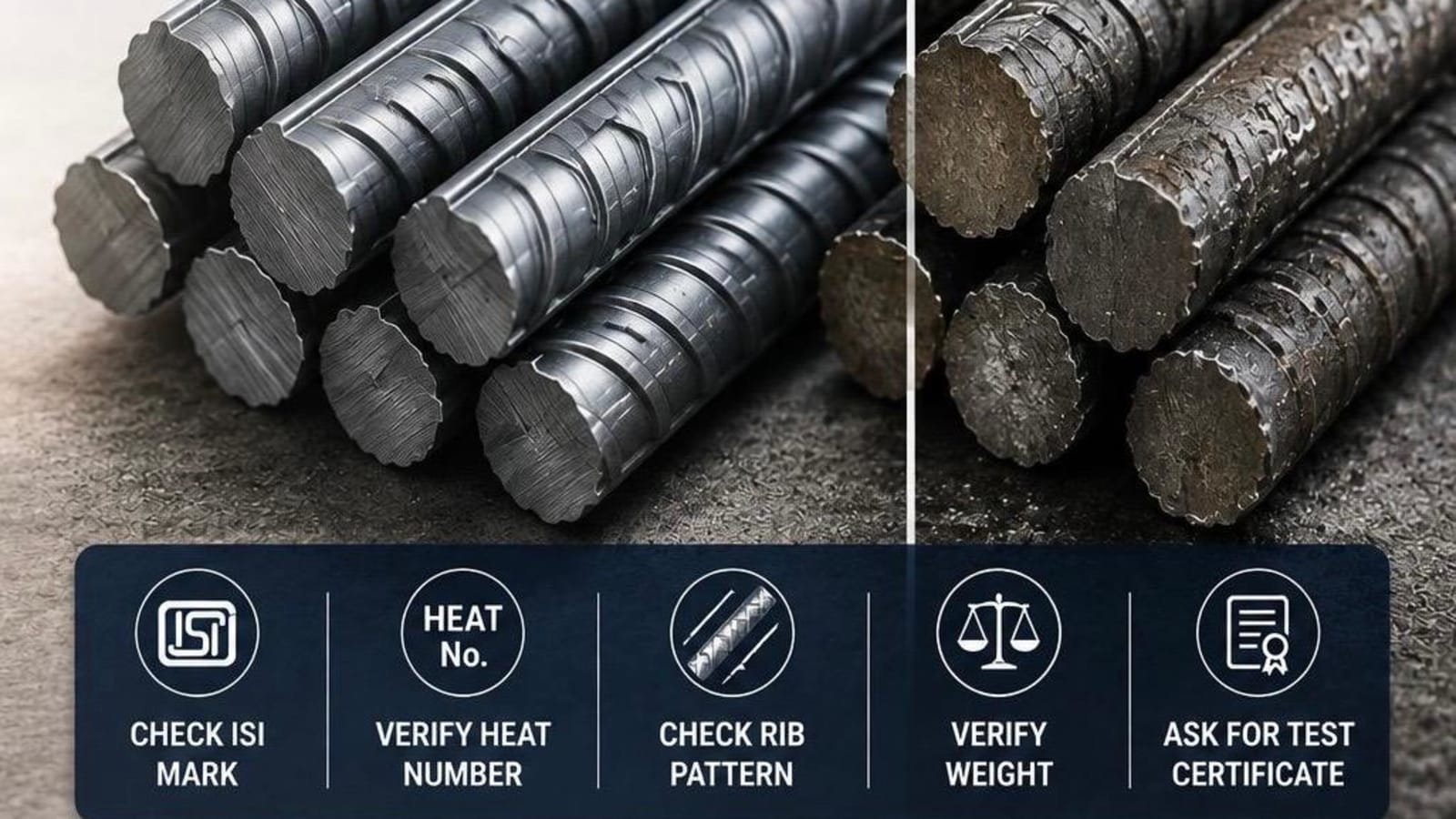
Separate from design considerations, there's a purely commercial risk buyers should watch for: bars billed as one diameter but actually undersized. This isn't always intentional — sometimes it's a manufacturing tolerance issue — but either way, it means less actual steel cross-section than your design assumes. It's reasonable to spot-check bar diameter against what's billed on large orders, particularly using a simple caliper check across a sample from each bundle.
Final Word
Diameter selection is a structural engineering decision, not a convenience choice based on building type or what's easiest to source. The safest approach is straightforward: work from your structural engineer's drawings for both diameter and grade, confirm availability with your supplier ahead of time, and verify what's delivered matches what was ordered.
At Baheti Steel Traders, we stock the full range of diameters — 6mm through 32mm — across all our Hyderabad branches, so you can order exactly what your BOQ specifies without last-minute substitutions or compromises.